


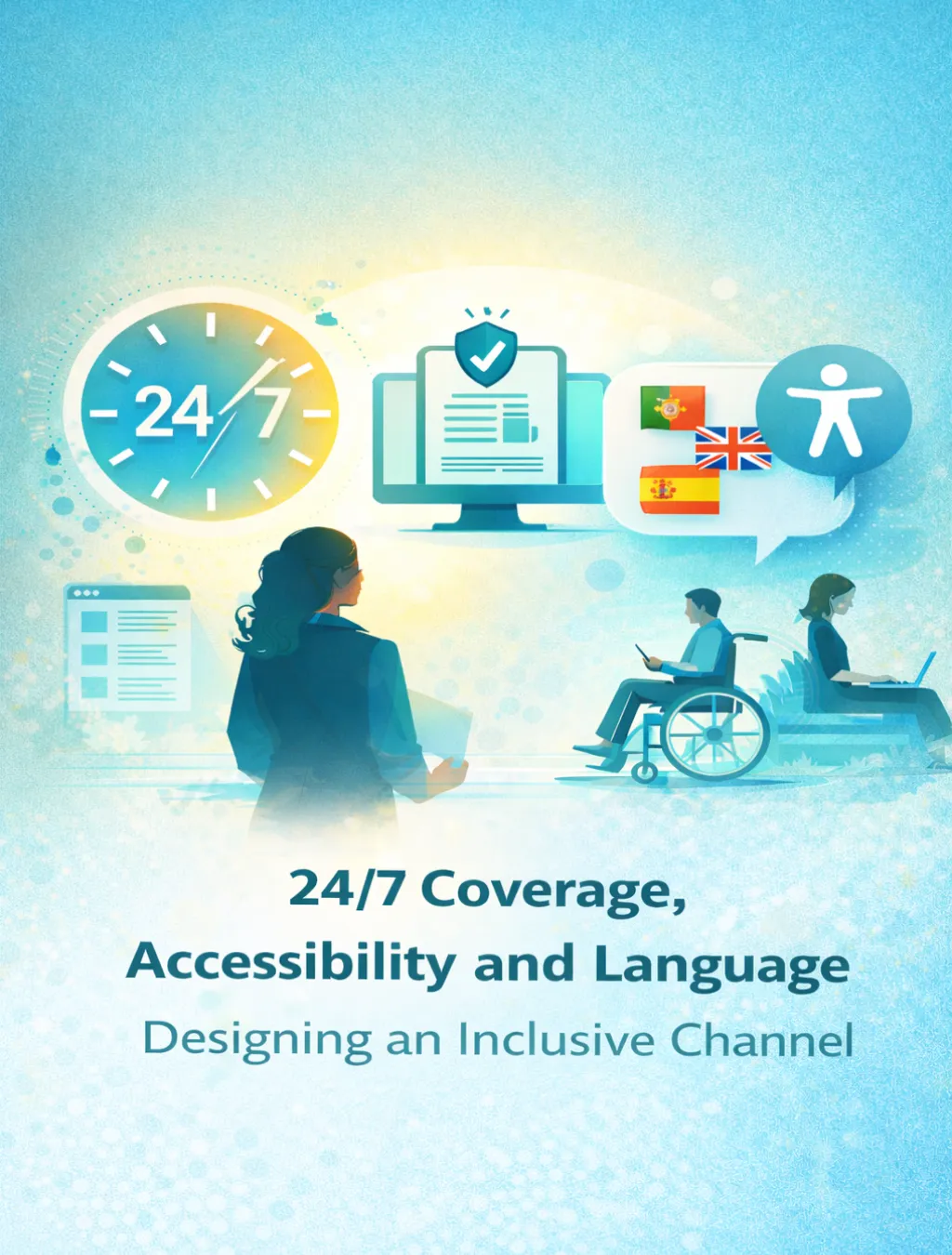
Why Designing an Inclusive Whistleblowing Channel, Matters?
A reporting channel only works when people can actually use it at the moment they need it, in a format they can navigate and in a language they can trust themselves to use accurately. In practice, that means an inclusive whistleblowing channel cannot be designed only for office-based staff, during business hours, in one language, and for users with strong digital confidence.
Organisations that take ethics, compliance and trust seriously need to do more. They need to provide 24/7 coverage, accessible design, appropriate language support, clear instructions and an operating model capable of responding consistently. Otherwise, the risk is not only legal or reputational. It is operational and human. Someone who cannot report safely and easily may delay, give up or choose a completely different route.
For HR, CSR and ESG teams, this matters because a whistleblowing arrangement is not just a formal requirement. It is part of organisational culture, prevention and risk management. A poorly designed system reduces trust. A well-designed one improves early detection, reduces unnecessary escalation and demonstrates that the organisation is prepared to listen, protect and act.
This article explains how to design an inclusive whistleblowing channel with practical steps, roles, a realistic timeline, common risks, one mini-scenario and a suggested downloadable template to support implementation.
What does an inclusive whistleblowing channel actually mean?
An inclusive channel is built for the real mix of users around the organisation. That includes shift workers, remote staff, factory teams, suppliers, partners, temporary workers, former employees and, in some cases, customers or other third parties entitled to raise concerns.
In practice, an inclusive whistleblowing channel combines six core principles:
- Continuous availability. People should be able to report whenever an issue arises, not only when the internal team is online.
- Real accessibility. The channel should be usable by people with visual, auditory, motor or cognitive limitations, as well as those with lower digital confidence.
- Relevant language coverage. Reporting options should reflect the organisation’s workforce and operating footprint.
- Clarity and simplicity. Overly legalistic language, long forms and unnecessary complexity discourage use.
- Protection of identity and information. Confidentiality, anonymity where permitted, data minimisation and restricted access are essential.
- Operational response. Receiving a report is only the start. Triage, follow-up and resolution must be designed properly.
If one of these elements is missing, the channel may exist technically, but it is not truly inclusive.
Why do so many channels fail?
Many reporting channels fail because they are designed from the organisation’s perspective rather than the user’s.
Common problems include:
- A form available in only one language in a multilingual business.
- A desktop-first design in organisations where many workers rely on mobile devices.
- A “24/7 hotline” that receives reports at any time but offers poor instructions, weak language support and no meaningful triage process.
- Forms that ask too many questions too early.
- Automatic messages that confirm nothing useful and leave the reporter unsure about what happens next.
- Access rights that are too broad internally, weakening confidence in confidentiality.
- No clear retention rules, weak data minimisation and poor alignment with data protection obligations.
The outcome is predictable: lower trust, poorer-quality reports, more friction and fewer people using the channel when it matters.
This topic complements existing iBlow.eu content on SME whistleblowing challenges, technology and anonymity, and managing false reports without damaging trust.
The 7 pillars of an inclusive whistleblowing channel
1. 24/7 coverage without misleading claims
Twenty-four-seven coverage does not mean a full investigation begins at 2 a.m. It means the channel is safely available at all times for intake, with a reliable mechanism for confirmation, logging and continuity.
For most organisations, that means a combination of:
- a secure web portal;
- a mobile-friendly reporting form;
- written reporting options;
- secure document upload;
- a protected follow-up mailbox or case space;
- clear routing and triage rules.
Whenever an organisation states that its channel is available 24/7, it should explain what that means in practice: always-on submission, clear acknowledgement, and human triage within a defined service level.
Promising constant availability and then leaving reporters without meaningful feedback for days undermines trust very quickly.
2. Accessibility by design, not as an afterthought
Accessibility should not be bolted on later. It needs to be part of the channel design from the beginning.
Minimum good practice includes:
- keyboard navigation;
- screen-reader compatibility;
- sufficient contrast;
- clear field labels;
- simple instructions;
- plain language;
- alternatives to audio-only or visual-only content;
- sensible session timing;
- properly functional mobile use.
Where possible, the channel should be reviewed against digital accessibility principles aligned with WCAG 2.1 AA. For HR, CSR and ESG teams, this is not merely a technical standard. It is part of inclusion in practice.
3. Language: let people report in the language they can trust
A frequent mistake is limiting reporting to the main corporate language. That excludes people who can work in that language day to day but do not feel able to describe sensitive facts accurately under pressure.
The practical rule is straightforward: channel language options should reflect organisational reality. Consider:
- the main languages spoken across the workforce;
- countries where the organisation operates;
- critical supplier or contractor environments;
- shift-based, logistics or industrial settings;
- external audiences who may also need to report.
Not every organisation needs ten languages on day one. But every organisation should define a language coverage policy. For example: the main operating language, one secondary corporate language, plus other languages relevant to the workforce profile.
It is also important to define how reports submitted in different languages will be triaged. Translation support can help, but sensitive reporting should never rely on machine output alone without human review.
4. Confidentiality, anonymity and data protection
An inclusive whistleblowing channel also depends on how well it protects both people and information.
That means:
- collecting only necessary data;
- defining tightly restricted access roles;
- separating intake, triage and investigation functions;
- limiting unnecessary exports and sharing;
- documenting retention rules;
- handling attachments securely;
- explaining data processing in clear terms.
This is where iPrivacy.eu becomes especially relevant: privacy by design, lawful processing, transparency, retention and access controls must all align with applicable GDPR expectations. Where a more structured governance layer is needed across the wider compliance programme, iCompliance.eu can support the implementation of processes, controls and evidence management.
5. Clear roles and responsibilities
Without governance, channels deteriorate.
Roles should be defined from the start:
- HR / People / CSR / ESG help shape communication, awareness and cultural trust.
- Compliance / Ethics / Legal define intake criteria, triage logic and escalation routes.
- DPO / privacy stakeholders review retention, minimisation, information notices and access control.
- IT / Security support availability, resilience, authentication and technical safeguards.
- Internal or external investigators handle complex matters with independence and method.
- Management provides sponsorship, budget and non-interference.
Where technology supports the process, it is helpful to connect the channel to a broader operational layer. iComply.pt can be positioned as the technology platform supporting tasks, evidence, controls and programme follow-up around the whistleblowing process.
6. Service levels, user experience and trust
Someone making a report needs to understand three things: the report was received, it will be handled seriously, and the process has not disappeared into a black hole.
Strong user experience includes:
- a clear submission confirmation;
- a secure case reference;
- a plain explanation of next steps;
- protected follow-up messaging;
- proportionate updates;
- respectful, understandable language.
Useful metrics include:
- submission volumes by channel;
- percentage of cases where follow-up is possible;
- time to first response;
- time to triage;
- time to closure;
- reports by language;
- mobile versus desktop use;
- accessibility issues raised;
- form abandonment.
These measures help turn a formal mechanism into a managed improvement system.
7. Training, communication and cultural trust
Even the best channel fails if people do not know it exists or do not trust it.
The launch plan should explain:
- who can use the channel;
- what can be reported;
- which formats are available;
- how confidentiality works;
- whether anonymous reporting is possible;
- what should not be sent through the channel;
- what happens after submission.
Good communication uses realistic examples, FAQs and audience-specific wording. A warehouse worker on a late shift does not engage with the same message style as a senior office-based manager.
A realistic mini-scenario
A manufacturing company operating in Portugal and Spain had a web-based reporting channel available only in Portuguese and English. Office teams could use it, but the business also relied heavily on shift-based operational workers, including temporary staff more comfortable in Spanish and Romanian.
A night-shift employee spotted irregular behaviour linked to local purchasing but hesitated to report it. The form felt long, the wording was legalistic, and the employee was not confident about describing the facts accurately in Portuguese. Two weeks later, the issue surfaced informally and had already grown more complex.
During the channel review, the company made five changes: it simplified the intake form, improved mobile usability, added Spanish, created a controlled approach for other languages, clarified confidentiality and introduced a secure follow-up mailbox. Within six months, the quality of incoming reports improved, incomplete submissions fell and internal trust in the system increased.
The lesson is clear: the barrier is not always fear of speaking up. Often, it is friction in channel design.
A practical 90-day implementation timeline
Days 1 to 30: assess and design
Map users, languages, current channels, privacy requirements, accessibility gaps, access profiles and response expectations. Define scope, ownership, service levels and escalation logic.
Days 31 to 60: configure and test
Configure the channel, review wording, test mobile access, validate plain language, define automated responses, review retention and test triage workflows. Use real-user testing wherever possible.
Days 61 to 90: launch and measure
Launch with clear communication, audience-specific FAQs, short training for key roles and an initial KPI dashboard. Measure usage, language patterns, abandonment, response times and user feedback.
Practical checklist for an inclusive whistleblowing channel
Use this as an internal validation list:
- Is the channel safely available 24/7 for intake?
- Does it work properly on mobile devices?
- Can it be used by keyboard and screen readers?
- Is the wording clear and free of unnecessary jargon?
- Do available languages reflect workforce reality?
- Is there a policy for handling reports in additional languages?
- Is confidentiality explained in simple terms?
- Are internal access rights limited by role?
- Are response deadlines defined and monitored?
- Is there a secure follow-up mechanism?
- Does the reporter understand what happens next?
- Are accessibility, language, timing and abandonment measured?
- Is the channel aligned with privacy, compliance and security?
- Does internal communication explain when and how to use it?
Common risks and how to avoid them
The first risk is a paper channel: something that exists formally but performs poorly in real life. The fix is to measure real usage, friction and completion.
The second risk is performative inclusion: multiple languages on the landing page, but no realistic way to triage the reports received. The fix is a workable language coverage model.
The third risk is over-design. The more demanding the intake form, the higher the drop-off rate. The fix is to collect only what is necessary at the start.
The fourth risk is weak privacy discipline. The fix is data minimisation, controlled access and proper GDPR alignment, with support from iPrivacy.eu where needed.
The fifth risk is operational isolation. A reporting channel should connect with broader compliance workflows, evidence, remediation and governance. That is where iComply.pt and iCompliance.eu become particularly useful.
Conclusion
Designing an inclusive whistleblowing channel is not about adding isolated features. It is about creating a coherent, usable and trustworthy system for real people in real situations. Twenty-four-seven coverage, accessibility and language are not secondary design choices. They are central to trust, uptake and effectiveness.
For organisations that want a more mature operating model, the right combination of channel capability, governance and data protection makes a measurable difference. iBlow.eu can support the reporting channel itself, iComply.pt can strengthen the programme’s technology and control layer, iPrivacy.eu can align the GDPR and privacy dimension, and iCompliance.eu can support the broader compliance implementation model.
Book a demo · See package prices · Download the checklist
FAQ
What is an inclusive whistleblowing channel?
An inclusive whistleblowing channel is a reporting channel designed to be accessible, easy to use and available to different types of users. It should support 24/7 intake, clear language, confidentiality, accessibility and appropriate language options.
Should a whistleblowing channel be available 24/7?
Yes. A whistleblowing channel should allow reports to be submitted at any time, including outside normal business hours. While human review may follow defined service levels, intake should remain available 24/7.
How many languages should an inclusive whistleblowing channel support?
An inclusive whistleblowing channel should support the languages that reflect the organisation’s workforce, operations and relevant third parties. The right number depends on actual reporting needs, not a fixed rule.
Why are accessibility and usability important in whistleblowing channels?
Accessibility and usability help ensure that more people can report concerns safely and confidently. A whistleblowing channel should work well on mobile, use clear wording and support users with different accessibility needs.
How does GDPR apply to a whistleblowing channel?
GDPR applies through privacy by design, data minimisation, access controls, retention rules and transparent information for users. A whistleblowing channel should protect personal data while supporting confidential reporting.
Can an inclusive whistleblowing channel improve reporting quality?
Yes. When a whistleblowing channel is accessible, multilingual and easy to use, people are more likely to submit reports earlier and with clearer information. This can improve trust, follow-up and case quality.