


Whistleblowing Triage
A whistleblowing channel is not just another contact form. It is a protected reporting route for specific concerns that may involve legal breaches, serious misconduct, corruption, fraud, public-interest risks, retaliation or attempts to conceal wrongdoing.
Yet, in many organisations, the first operational challenge is not the technology. It is routing.
A report arrives. Is it a whistleblowing disclosure? A personal HR grievance? A Code of Ethics concern? A health and safety incident? A data protection issue? A conflict between colleagues? A supplier complaint? A near miss? A retaliation allegation?
If the organisation routes it incorrectly, the consequences can be serious: confidentiality may be broken, deadlines may be missed, evidence may be lost, the wrong people may see sensitive information, retaliation risks may increase, and employees may conclude that the reporting system cannot be trusted.
That is why every whistleblowing programme needs a clear triage model.
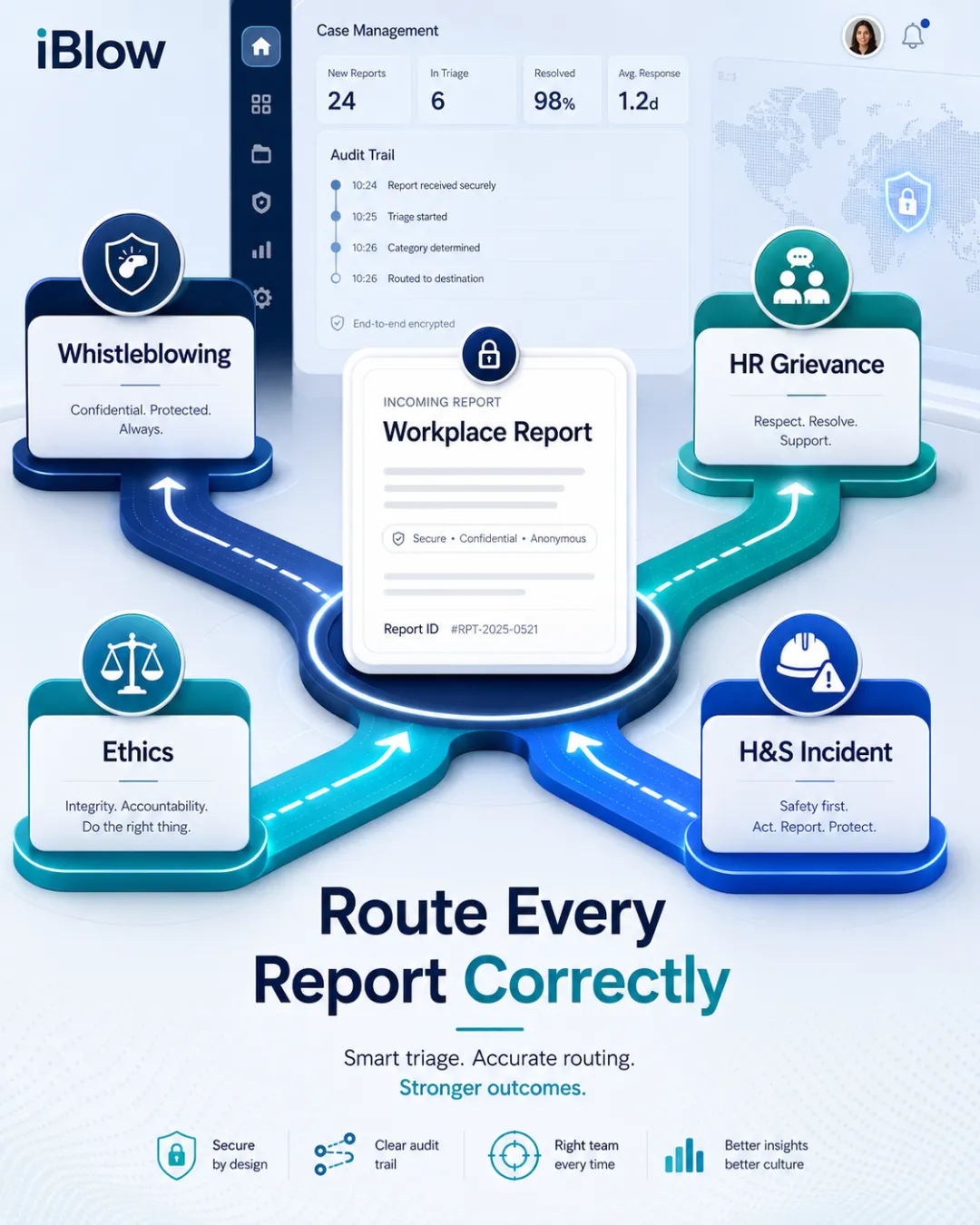
This article explains how to distinguish between four common routes — whistleblowing, HR grievance, ethics and health & safety — and how to design a practical decision framework that protects people, preserves evidence and gives each report the right response.
Why correct routing matters
A mature speak-up system is not measured only by how many reports it receives. It is measured by whether each concern is handled through the right process, by the right people, within the right timeframe, with the right confidentiality controls.
Correct routing matters for five reasons.
First, it protects the reporting person. A whistleblower may face retaliation, isolation or career damage if their identity is disclosed unnecessarily. A sensitive employment complaint may also require discretion, but the legal protections, investigation model and communication rules may differ.
Second, it protects the accused person. Even serious allegations must be handled fairly, proportionately and without premature conclusions. Poor routing can create reputational harm before the facts are established.
Third, it protects evidence. Some reports require immediate preservation of documents, access logs, emails, CCTV, financial records or system data. If the report is treated as an ordinary HR issue, key evidence may disappear before anyone realises the seriousness of the matter.
Fourth, it protects the organisation. Regulators, auditors, employees and courts may later ask: who received the report, how was it classified, who had access, what was done, and why?
Finally, it protects trust. If employees see that the organisation sends serious reports to conflicted managers, ignores safety alerts or treats whistleblowing as “just an HR matter”, they will stop using internal channels and may go external.
The four main reporting routes
1. Whistleblowing channel
The whistleblowing channel should be used when the report concerns serious wrongdoing, legal or regulatory breaches, corruption, fraud, misuse of funds, public-interest risks, serious misconduct, retaliation, cover-up attempts, or breaches that fall within the organisation’s whistleblowing policy.
Examples may include:
- suspected bribery or corruption;
- fraud, falsification of records or misuse of company assets;
- serious data protection or cybersecurity breaches;
- procurement manipulation or conflict of interest;
- environmental, health or public safety risks;
- retaliation against someone who raised a concern;
- attempts to conceal wrongdoing;
- systemic harassment or discrimination where there may be wider organisational failure;
- reports involving senior managers or people who would normally handle the complaint.
The whistleblowing route usually requires restricted access, confidentiality by design, conflict-of-interest screening, secure case management, evidence preservation, documented follow-up and clear communication with the reporting person.
Not every workplace complaint is whistleblowing. But some employment-related complaints can become whistleblowing if they reveal a broader breach, serious risk, abuse of authority, retaliation or a pattern that affects more than one individual.
The key question is not: “Does this involve an employee?”
The key question is: “Does this report disclose a serious concern that may require protected handling?”
2. HR grievance
An HR grievance normally concerns an individual employment issue between the employee and the employer, a manager or a colleague.
Examples may include:
- disagreement with a performance appraisal;
- salary, benefits, working hours or leave disputes;
- interpersonal conflict between colleagues;
- dissatisfaction with workload or management style;
- individual complaints about promotion, role definition or team allocation;
- complaints about working conditions that do not indicate a wider legal or public-interest risk.
HR grievances still matter. They can be emotionally difficult, operationally disruptive and legally sensitive. But they are usually handled through HR procedures, line-management escalation or labour-relations processes.
The danger is assuming that every people-related issue belongs only to HR.
A grievance should be escalated or cross-routed when it includes signs of retaliation, discrimination, harassment, abuse of power, concealment, falsified records, serious misconduct, or involvement of senior leaders. In those cases, HR may still be involved, but it should not necessarily own the process alone.
A simple rule helps:
If the issue is mainly about an individual employment dispute, HR may be the primary route.
If the issue suggests serious wrongdoing, systemic risk, retaliation or breach of law, the whistleblowing channel should be considered.
3. Ethics or Code of Conduct concern
Ethics concerns often sit between HR and whistleblowing. They may not immediately appear illegal, but they affect the organisation’s integrity, culture and trust.
Examples include:
- conflicts of interest;
- inappropriate gifts or hospitality;
- misuse of company resources;
- pressure to manipulate internal reports;
- disrespectful behaviour inconsistent with company values;
- undisclosed relationships affecting business decisions;
- unfair treatment of suppliers or customers;
- behaviour that breaches the Code of Conduct but may not yet amount to a legal breach.
Some organisations manage ethics concerns through Compliance, Legal, Ethics Committees or dedicated conduct officers. Others use the whistleblowing channel as the intake route for both ethics and whistleblowing reports, applying triage afterwards.
That can work well, provided the organisation is transparent. Employees do not need to master legal categories before speaking up. They need a safe route and confidence that the organisation will classify the matter properly.
A good policy should therefore say: “If you are unsure where to report, use the speak-up channel. We will route the matter appropriately while protecting confidentiality.”
This prevents under-reporting and avoids forcing employees to decide whether something is “serious enough”.
4. Health & Safety incident or near miss
Health and safety reports are often urgent. They may involve accidents, near misses, unsafe equipment, dangerous behaviours, occupational illness, inadequate protective equipment, unsafe working conditions or emergency risks.
Examples include:
- a machine guard removed from equipment;
- repeated near misses in a warehouse;
- unsafe manual handling practices;
- chemical exposure;
- blocked emergency exits;
- lack of PPE;
- dangerous driving practices;
- a serious accident not recorded correctly.
Many H&S issues should be handled immediately through the safety management system, because the priority is to remove the hazard, protect people and prevent recurrence.
However, some H&S reports should also be treated as whistleblowing concerns.
This is especially true when there are signs of concealment, falsified accident records, ignored repeated warnings, pressure not to report incidents, deliberate non-compliance, retaliation against workers who raise safety concerns, or systemic failures affecting multiple workers.
The routing principle is therefore:
Immediate danger goes to H&S response immediately.
Concealment, retaliation or deliberate non-compliance also triggers whistleblowing escalation.
The two routes are not enemies. In serious cases, they must work together.
Practical triage questions
When a report arrives, the first reviewer should not jump to conclusions. They should ask structured questions:
- What is the core allegation?
- Is there an immediate risk to life, safety, health, evidence or systems?
- Does the matter involve a possible breach of law, regulation, internal policy or Code of Conduct?
- Is the issue individual, systemic or both?
- Is the reporting person asking for personal employment redress, or reporting wrongdoing?
- Are senior managers, HR, Compliance, Legal or H&S potentially conflicted?
- Could the matter involve retaliation?
- Is anonymity or enhanced confidentiality necessary?
- What evidence may need to be preserved immediately?
- Which process gives the safest, fairest and most compliant response?
The output of triage should not be a vague label. It should be a documented routing decision:
- primary route;
- secondary stakeholders;
- access restrictions;
- urgency level;
- evidence preservation actions;
- conflict-of-interest checks;
- communication plan;
- next review date.
A simple routing matrix
| Type of report | Primary route | Typical owner | Key risk | Escalate to whistleblowing when… |
|---|---|---|---|---|
| Suspected fraud, corruption, legal breach | Whistleblowing | Compliance / Legal / Independent case owner | Retaliation, evidence loss, legal exposure | Always consider whistleblowing handling |
| Salary, appraisal or workload dispute | HR grievance | HR / People team | Labour conflict, morale, fairness | Retaliation, discrimination, cover-up or senior conflict exists |
| Conflict of interest, gifts, conduct concerns | Ethics / Compliance | Compliance / Ethics owner | Cultural erosion, hidden misconduct | Serious breach, concealment, procurement risk or senior involvement exists |
| Accident, near miss, unsafe equipment | H&S incident process | H&S / Operations | Immediate harm, recurrence | Records are falsified, warnings ignored, retaliation alleged or systemic failure exists |
| Complaint against the normal process owner | Independent route | Legal / external investigator / alternative case owner | Conflict of interest | The usual owner cannot handle it independently |
The first 24 hours: what should happen?
The first 24 hours after receipt are critical. The organisation does not need to solve the case immediately, but it must stabilise the risk.
The first reviewer should:
- log the report securely;
- restrict access to those who need to know;
- check whether there is immediate risk to people, evidence or systems;
- identify possible conflicts of interest;
- acknowledge receipt where applicable;
- preserve key evidence;
- avoid alerting implicated persons too early;
- decide whether urgent protective measures are needed;
- define the provisional route;
- schedule a triage review.
What should never happen?
The report should not be forwarded casually by email. It should not be sent to the manager named in the allegation. It should not be discussed informally in open channels. It should not be dismissed as “just HR” without checking for retaliation, systemic risk or legal breach.
Mini-scenarios
Scenario 1: “My manager is unfair and blocks my promotion.”
This may start as an HR grievance. The employee is challenging management behaviour and career progression. HR should assess the facts, check consistency with policy and ensure fair treatment.
But if the employee says the blocked promotion happened after they reported safety concerns, the matter may involve retaliation and should be escalated into protected handling.
Scenario 2: “A supplier gives gifts to the procurement manager before tenders.”
This is not merely an ethics concern. It may involve conflict of interest, procurement manipulation, bribery risk and financial harm. The whistleblowing or ethics/compliance route should handle it, with restricted access and evidence preservation.
Scenario 3: “A warehouse near miss keeps happening, but supervisors tell us not to record it.”
The immediate hazard belongs to H&S. But the instruction not to record near misses suggests concealment and potential retaliation risk. This should trigger both urgent safety action and whistleblowing escalation.
Scenario 4: “A colleague is rude to me every day.”
This may be HR, conduct or harassment, depending on severity, pattern and protected characteristics. If it is interpersonal conflict, HR may own it. If there is harassment, discrimination, abuse of authority or failure by management to act, it may require escalation.
Common routing mistakes
The most common mistake is treating the whistleblowing channel as a dumping ground for every complaint. That overwhelms the system and creates unrealistic expectations.
The second mistake is the opposite: keeping too many concerns inside HR or line management, even when there are signs of retaliation, senior involvement or legal breach.
The third mistake is allowing conflicted people to decide whether a case is serious. If the allegation concerns a manager, that manager should not control the route.
The fourth mistake is separating technology from governance. A secure platform is essential, but it will not fix unclear ownership, weak policies or untrained managers.
The fifth mistake is failing to measure misrouting. If many reports are reclassified late, if employees repeatedly use the wrong channel, or if cases are reopened because the first route failed, the programme needs improvement.
Metrics to monitor
A good dashboard should track:
- number of reports by category;
- percentage reclassified after triage;
- average time to first assessment;
- reports involving retaliation risk;
- reports involving conflicts of interest;
- cases escalated from HR, Ethics or H&S into whistleblowing;
- cases referred out of whistleblowing to another process;
- evidence preservation time;
- overdue acknowledgements or follow-up;
- repeat issues by department, site or manager.
These metrics help the Board and senior leadership understand whether the organisation has a real speak-up system or only a formal policy.
How iBlow helps
iBlow helps organisations move from informal reporting to structured, secure and auditable whistleblowing governance.
A mature configuration can support:
- confidential and anonymous reporting;
- structured intake forms;
- categorisation and triage workflows;
- restricted case access;
- audit trails;
- secure communication with reporting persons;
- evidence management;
- role-based responsibilities;
- reporting dashboards;
- support for policies, procedures and training.
The goal is not to replace HR, Ethics, Legal or H&S. The goal is to connect them through a safer routing model, so each report reaches the right process without losing confidentiality, evidence or trust.
Practical Whistleblowing Governance
Is every report reaching the right process?
Misrouting a report can expose whistleblowers, delay investigations, lose evidence and damage trust. iBlow helps organisations structure confidential intake, triage, case management and reporting so that whistleblowing, HR, Ethics and H&S teams work together without compromising protection.
- Secure and anonymous reporting channels
- Structured triage workflows and restricted case access
- Audit trails, evidence management and reporting dashboards
- Support for policies, procedures, training and governance
Conclusion
The question is not whether a report belongs to HR, Ethics, H&S or whistleblowing in abstract terms. The question is: which route protects people, evidence, fairness and compliance best?
A mature organisation does not ask employees to solve that puzzle alone. It gives them a safe reporting channel, explains the main routes clearly and builds a triage process that can classify, escalate or redirect reports without exposing the reporting person.
Whistleblowing works when people trust not only the channel, but also what happens after they press “submit”.
Correct routing is where that trust begins.
FAQ 1 — What is whistleblowing triage?
Whistleblowing triage is the initial assessment of a report to decide whether it should be handled as whistleblowing, HR grievance, ethics concern, H&S incident or another process, while preserving confidentiality and evidence.
FAQ 2 — Is every HR complaint a whistleblowing report?
No. Many HR complaints are individual employment grievances. However, an HR issue may require whistleblowing handling if it involves retaliation, discrimination, serious misconduct, abuse of power, legal breach or systemic failure.
FAQ 3 — Can a health and safety report also be whistleblowing?
Yes. Immediate safety hazards should trigger H&S action, but the case may also be whistleblowing if there is concealment, falsified records, ignored warnings, retaliation or deliberate non-compliance.
FAQ 4 — Who should decide the routing of a report?
Routing should be decided by trained, independent reviewers using documented criteria, conflict-of-interest checks and restricted access. The person named in the allegation should never control the routing decision.
FAQ 5 — How can iBlow support report routing?
iBlow supports secure intake, anonymous reporting, structured triage, restricted case access, evidence management, audit trails and dashboards to help organisations route reports safely and consistently.