


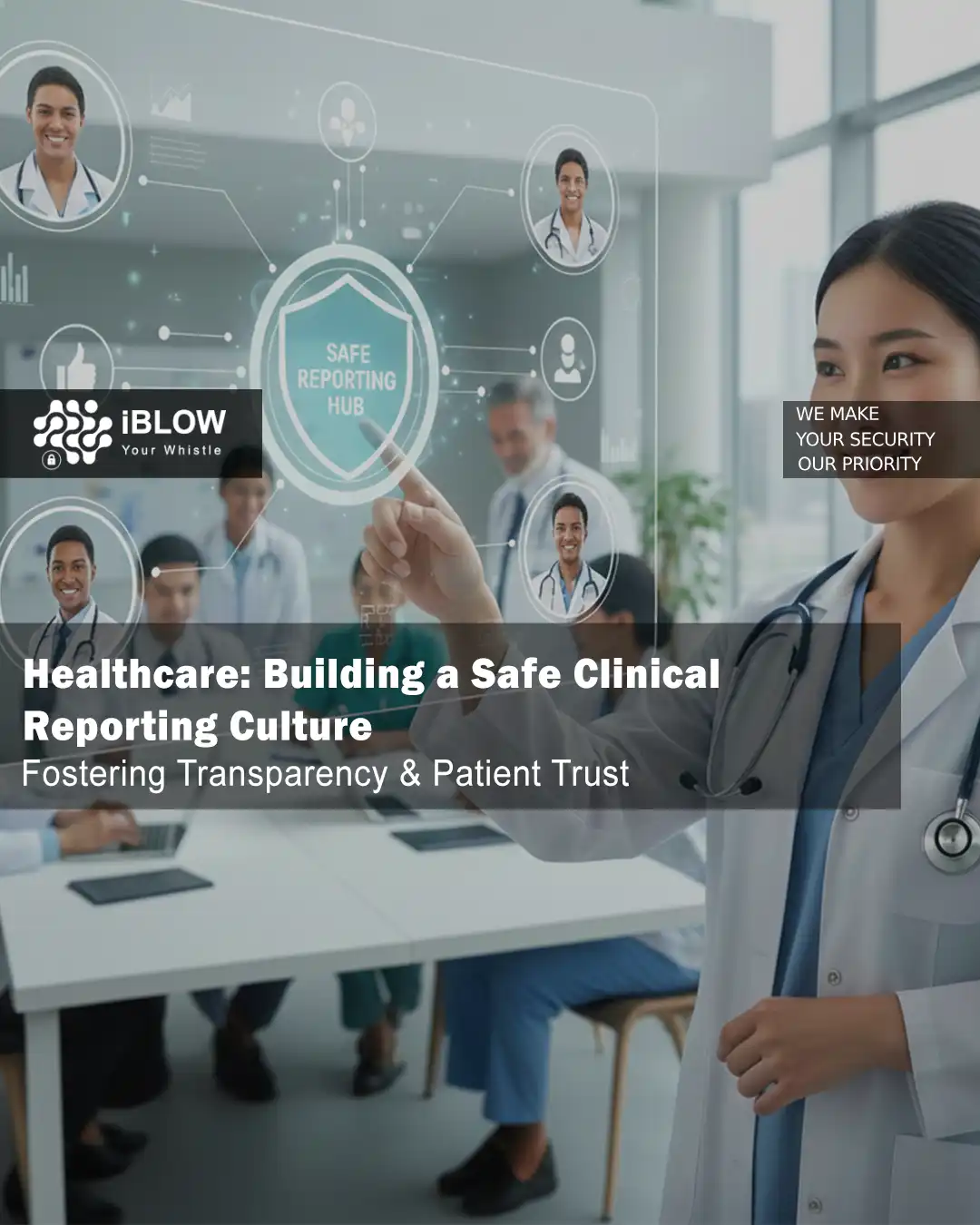
1. Why Healthcare Needs a Safe and Modern Clinical Reporting Culture
Healthcare organisations — including hospitals, clinics, long-term care institutions and university-affiliated teaching environments — operate in an environment where clinical error, ethical risk and organisational pressure coexist daily.
Yet research consistently shows that:
-
Most clinical professionals witness issues they do not report.
-
Fear of retaliation remains the largest barrier to speaking up.
-
Education-sector healthcare institutions (medical universities, teaching hospitals, and integrated academic centres) face extra layers of hierarchy and complex reporting structures, increasing risk.
A safe clinical reporting culture is not a “nice to have”. It is:
-
A patient-safety requirement
-
A regulatory obligation (EU Whistleblowing Directive, GDPR, national health compliance frameworks)
-
A strategic advantage, improving quality of care and reducing litigation
This guide provides practical steps, checklists, role definitions, timelines and a real-world scenario for hospital and academic healthcare compliance leads.
2. What Is a Safe Clinical Reporting Culture?
A safe reporting culture is one where:
-
Staff trust the reporting system
-
Anonymous reporting is possible and technically guaranteed
-
Investigations follow strict protocols
-
No form of retaliation — formal or informal — is tolerated
-
Leaders actively demonstrate support for transparency
-
Students, interns and newly-licensed professionals feel safe to speak up
This is particularly critical in education-sector healthcare, where trainees may feel extremely vulnerable.
3. Core Principles for Clinical Reporting in Healthcare + Education
3.1 Anonymity by Design
A modern whistleblowing channel must ensure:
-
Technical anonymity (no metadata, no cookies, no IP logs)
-
Encrypted submission and retrieval
-
Secure internal communication without exposing identity
Tools like iBlow.eu provide this natively, reducing IT and compliance risk.
3.2 GDPR-Aligned Data Handling
Healthcare data is highly sensitive.
The reporting system must:
-
Collect only what is strictly necessary
-
Apply access controls
-
Ensure audit trails
-
Be supported by proper DPIA documentation (iPrivacy.eu can support)
3.3 Psychological Safety
Clinical and academic environments must promote:
-
Non-punitive reporting
-
Recognition of reporting as a patient-safety act
-
Mandatory training for all hierarchical levels
3.4 Clear Ownership and Governance
Define roles:
-
Report Handler(s)
-
Compliance Lead
-
Clinical Risk Manager
-
Data Protection Officer
-
Student/Training Programme Liaison
4. Step-by-Step Implementation Framework
Step 1 — Establish Governance (Weeks 1–2)
-
Appoint a Clinical Reporting Governance Group
-
Approve reporting policies
-
Train report handlers and department leads
-
Create a single digital access point
Deliverables:
✔ Reporting Policy
✔ Process Map
✔ Governance Charter
Step 2 — Select a Secure, Anonymous Digital Channel (Weeks 2–4)
Key requirements:
-
Full anonymity
-
Two-way encrypted communication
-
Multi-language support
-
Automated timelines
-
Evidence storage
Recommendation: Integrate iBlow.eu as your secure reporting channel.
Step 3 — Build Trust with Staff, Students and Clinical Trainees (Weeks 4–8)
Actions:
-
Create a communication campaign explaining the new culture
-
Clarify protections against retaliation
-
Provide training across departments
-
Use real examples (de-identified) to demonstrate system effectiveness
Deliverables:
✔ FAQ + guidance for clinicians
✔ Training videos or microlearning
✔ Posters and internal communication assets
Step 4 — Implement Investigation Protocols (Weeks 8–10)
Protocols must include:
-
Triage categories (clinical error, patient safety, misconduct, ethical breach, academic pressure, etc.)
-
Prioritisation indicators
-
Interview guidance
-
Documentation standards
-
Escalation rules
Investigators must be trained to avoid bias, especially when students or interns are involved.
Step 5 — Monitor, Evaluate and Improve (Continuous)
Key metrics:
-
Number of reports per department
-
Anonymous vs. identified submissions
-
Resolution times
-
Recurrence of similar issues
-
Training completion rates
-
Staff perception surveys
Use quarterly QBR-style compliance reviews to evaluate maturity.
5. Practical Checklist (Condensed)
A full downloadable checklist will be provided at the end.
✔ Governance
-
Roles appointed
-
Policy approved
-
DPO consulted
✔ Technology
-
Anonymous channel deployed
-
Encryption verified
-
Access controls tested
✔ Communication
-
Launch campaign completed
-
Training delivered
-
Student-specific messaging created
✔ Investigation
-
Protocol documented
-
Triage defined
-
Templates approved
✔ Continuous Improvement
-
Quarterly report
-
Annual audit
-
Feedback loop established
6. Real-World Mini Scenario
Context:
A 23-year-old medical student in a teaching hospital observes a senior surgeon repeatedly ignoring sterilisation protocols during high-pressure trauma cases.
Fear factors:
-
Hierarchical gap
-
Fear of being removed from the rotation
-
Reputation risk
Outcome with a weak culture:
The student remains silent. Infection rates rise. The risk becomes systemic.
Outcome with a safe reporting culture:
The student uses the anonymous reporting channel. The compliance team investigates confidentially.
Sterilisation workflows are updated, training repeated, and patient safety risk eliminated — without exposing the student.
This is the power of a functional clinical reporting system.
7. Risks of Not Implementing a Proper System
-
Patient safety incidents
-
Loss of accreditation for teaching institutions
-
GDPR fines due to improper data handling
-
Reputational damage
-
Increased litigation costs
-
Talent loss — especially among trainees
8. Internal Links (Suggested)
-
The Role of Technology in Safeguarding Whistleblower Anonymity
-
How to Manage False Reports Without Compromising Trust
-
The Importance of the Compliance Department
9. Calls to Action
- Book a demo of the iBlow.eu whistleblowing platform
- Book a demo of the iComply.pt multi law/ISO compliance platform
- Extra compliance services from iComliance.eu
- Download the checklist for implementation (write checklist in comments of this blog article, we’ll send it to you)
Be part of the conversation that is shaping the future of work! Book a meeting!
See other articles that may be of interest to you.
We hope you enjoyed this article.
Thank you!
Constantino Ferreira
iBlow.eu