


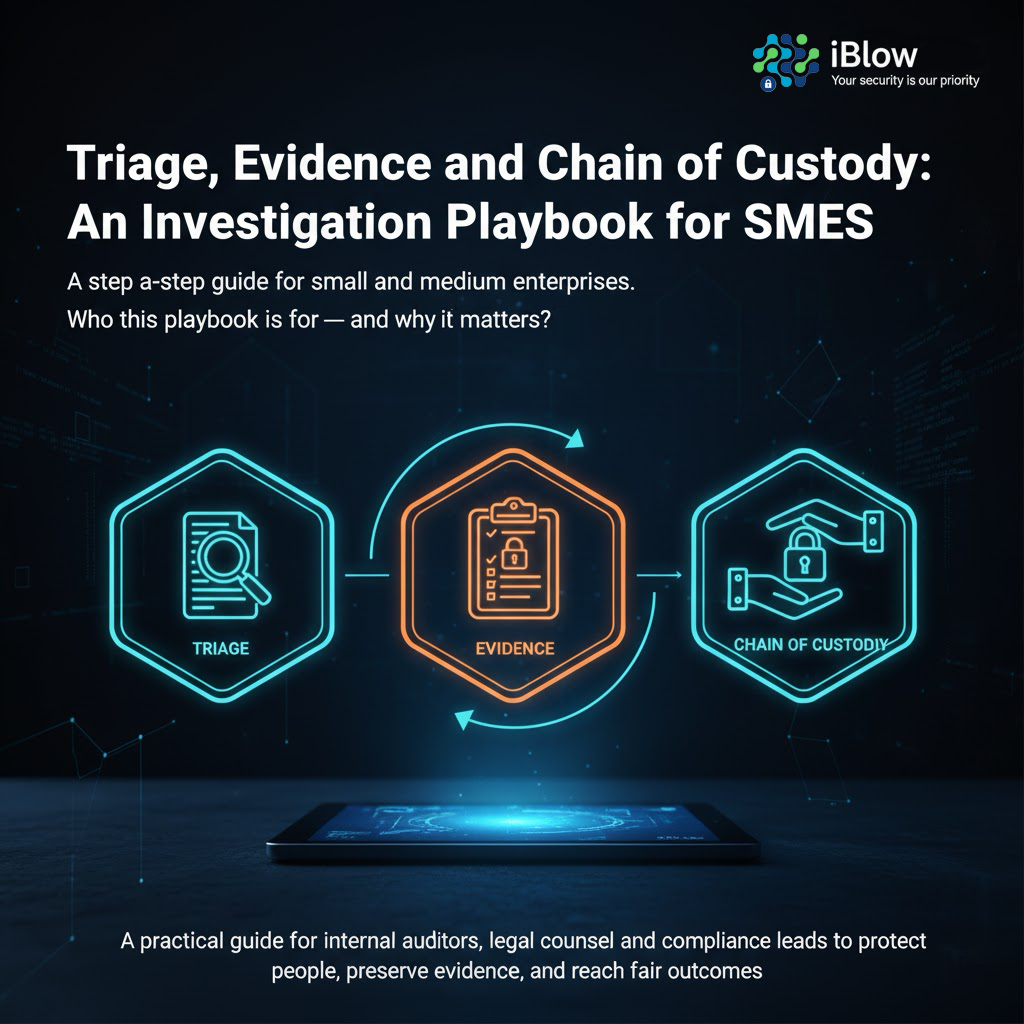
Who this playbook is for — and why it matters?
If you’re the internal auditor, legal counsel, or compliance lead of a small or mid-sized enterprise, you are likely to wear multiple hats. When a whistleblowing report lands, you need a disciplined process that protects people, preserves evidence, and reaches fair outcomes — without paralysing the business. This playbook distils proven practice into practical steps, ready-to-use checklists and clear roles so you can move from intake to closure with confidence.
The investigation workflow at a glance
- Intake & acknowledgement — log the report, protect confidentiality, and confirm receipt.
- Triage — quickly assess scope, risk, conflicts, and legal basis; decide whether to investigate or refer.
- Plan — define hypotheses, roles (RACI), sources, interviews, timeline and SLAs.
- Collect & preserve evidence — structured registers, hashes, storage controls.
- Interview — fair, documented, and proportionate.
- Analyse & conclude — test hypotheses, weigh credibility, link findings to policy.
- Outcome & remediation — corrective actions, control improvements, notifier feedback.
- Close & learn — metrics, KPIs and programme improvements.
Step 1 — Triage with discipline
Objective: decide fast, fairly and defensibly.
Checks (use the downloadable triage sheet):
- Eligibility & scope: does the allegation fall under your policy and the EU whistleblowing framework?
- Conflicts & independence: confirm case owner and escalation path (consider external counsel if needed).
- Risk rating: people safety, data/privacy exposure, financial impact, legal/press risk.
- Legal basis (GDPR): document purposes, minimisation and retention; involve the DPO when needed.
- Proportionality: is a formal investigation necessary or will a targeted management review suffice?
Decision options:
(a) acknowledge & log;
(b) escalate to formal investigation;
(c) refer/decline with rationale.
SLA tip: acknowledge within 7 days and provide an update/closure within 3 months (as a programme norm).
Step 2 — Assign roles and create a RACI
Clarity prevents drift. At minimum, assign:
- Case Owner (Responsible): runs day-to-day activities.
- Sponsor (Accountable): approves scope and conclusions.
- Advisers (Consulted): HR, DPO, IT forensics, external counsel.
- Observers (Informed): leadership, audit committee where proportionate.
RACI sample activities: intake & logging, triage decision, planning, evidence collection, reporting & outcomes.
Step 3 — Build your investigation plan
A good plan saves hours later. Include:
- Allegation statement & hypotheses to test (what would confirm/deny them).
- Evidence map: systems, documents, witnesses, and cut-off dates.
- Interview list & order: start with neutral context, then corroborative, then subject.
- Safeguards: confidentiality, retaliation prevention, and wellbeing.
- Timeline & SLAs: who does what by when, with escalation points.
- Data handling: legal basis, minimisation, retention, cross-border transfers (link to iPrivacy.eu for guidance).
Use the Investigation Plan table in the downloadable template to track tasks, owners, and due dates.
Step 4 — Evidence handling that stands up
Evidence must be authentic, complete and preserved:
- Register everything: create a unique Evidence ID, description, source, date/time, who collected it, and where it is stored.
- Integrity controls: hashes/checksums for digital files; tamper-evident seals for physical media.
- Versioning: never edit originals; work on copies with write-protection.
- Access control: least privilege; log who sees/handles what.
- Retention & deletion: tag personal data categories; follow policy-defined periods.
See the Evidence Register and Chain of Custody tables in the template.
Step 5 — Interviews that are fair and reliable
- Preparation: objectives, open questions, and a standard script (notice of purpose, confidentiality, and rights).
- Setting: private, neutral space; offer a companion if policy allows.
- Technique: start broad, drill down, seek documents, avoid leading questions.
- Records: contemporaneous notes; if recording, obtain explicit consent and store securely.
- Follow-ups: confirm facts and outstanding items within 48–72 hours.
Step 6 — Analysis and findings
- Triangulate documents, data and testimonies; track contradictions.
- Apply standards: weigh credibility, corroboration and plausibility; tie to your code/policies.
- Draft findings: fact pattern → policy breaches (if any) → root causes → impact.
- Quality check: legal counsel/DPO review for due process and privacy adherence.
Step 7 — Outcomes, remediation and notifier feedback
- Proportionate actions: ranging from coaching and policy updates to disciplinary measures.
- Control improvements: patch process gaps (segregation of duties, access reviews, training).
- Notifier feedback: respectful, non-retaliatory, and limited to what is lawful to share.
- Close the loop: log conclusions, store records securely, update KPIs.
Risks & how to avoid them
- Scope creep: lock the plan; any expansion requires sponsor approval.
- Evidence contamination: always preserve originals and document handling steps.
- Privacy violations: collect only what is necessary; document legal basis and retention.
- Retaliation: monitor for adverse changes in terms/conditions for involved parties.
- Timeline slippage: track SLAs; escalate early.
Mini-scenario (real-world style)
A purchasing officer is alleged to be favouring a supplier.
- Triage confirms relevance and moderate risk.
- Plan defines hypotheses: (H1) unusual purchase patterns; (H2) personal ties; (H3) policy breaches.
- Evidence: procure-to-pay logs, emails (targeted search), supplier master data, and interviews (requestor, finance, officer).
- Findings: two approvals bypassed; hospitality not recorded; email suggests undue pressure.
- Outcome: written warning, mandatory training, and tighter secondary approval controls.
- Notifier feedback sent within policy timelines.
Measure what matters (KPIs)
Leverage our internal article on Compliance KPIs to track: case acknowledgment time, triage decision time, plan sign-off time, average investigation duration, ratio of substantiated findings, remediation completion rate, and stakeholder satisfaction. Link improvements to your annual compliance plan.
Tools to speed you up
- iCompliance.eu — custom made services to tailor your implementation to your needs, CCO services.
- iComply.pt — technology platform for intake, case management, evidence logs and audit trails.
- iPrivacy.eu — GDPR guidance, DPO services and data-handling templates.
- iBlow.eu resources — comparative EU law analyses and SME-oriented guidance.
- iBlow.eu resources — download triage sheet
👉 Be part of the conversation that’s shaping the future of work! Book a meeting!
See other articles that may be of interest to you.
We hope you enjoyed this article.
Thank you!
Constantino Ferreira
iBlow.eu