


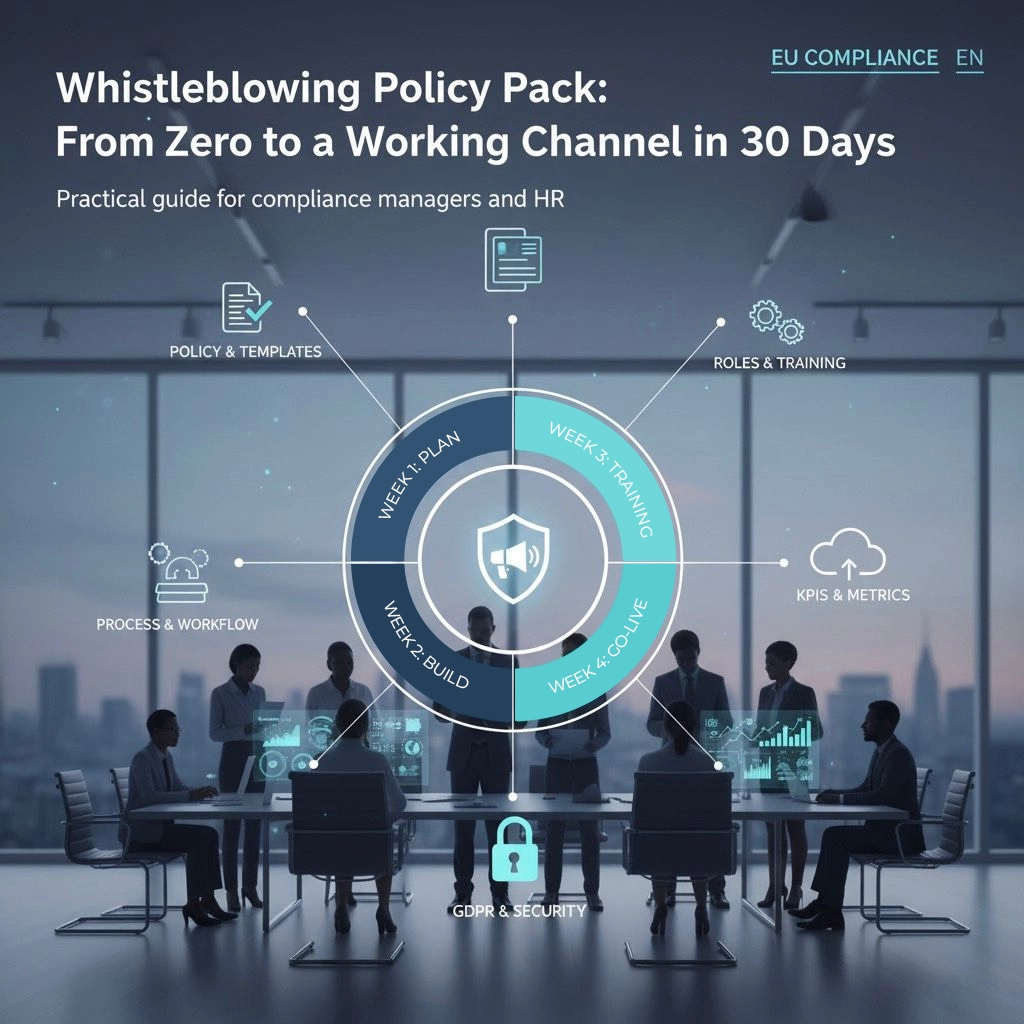
Introduction: Why 30 days is realistic
A working whistleblowing policy template doesn’t need to be a year-long programme. With a structured policy pack, clear roles, and a pragmatic rollout calendar, most SMEs and mid-caps can go live in 30 days—while staying aligned with EU whistleblower protection requirements and GDPR. This article provides your policy template, checklists, timeline, and risk controls so Compliance and HR can deliver quickly without cutting corners.
Outcomes you’ll achieve in 30 days
- A policy suite covering scope, confidentiality, non-retaliation, triage, and investigation.
- A secure reporting channel (web + email + optional hotline) with documented operating procedures.
- Roles & RACI for intake, assessment, investigation, data privacy, and reporting to management.
- Awareness kit for employees, contractors, and key third parties.
- KPIs & evidence to prove effectiveness to auditors and leadership.
For deeper measurement ideas, see Effectiveness of Whistleblowing Systems and Compliance KPIs (internal links above).
The Policy Pack (what’s inside)
- Master Whistleblowing Policy (Template)
Purpose, legal basis, scope (employees, applicants, suppliers), protected disclosures, confidentiality, non-retaliation, anonymity options, record-keeping and retention, escalation, and data minimisation.
- Procedure for Receiving and Assessing Reports
Intake paths (portal, email, hotline), eligibility checks, conflict-of-interest screening, risk-based triage, expected timelines, and acknowledgement scripts.
- Investigation Playbook
Roles, evidence handling, interviews, documentation standards, chain of custody, legal liaison, and close-out report structure.
- Data Protection Addendum
GDPR roles and responsibilities (controller/processor), lawful bases, DPIA guidance, retention and deletion rules, and data subject rights handling (with iPrivacy.eu best-practice pointers).
- Non-Retaliation & Support Policy
Definitions, prohibited behaviours, support mechanisms (EAP/HR), and specific remedies.
- Awareness Comms Kit
Launch email, intranet copy, posters, FAQs, and manager talking points.
- KPI Sheet & Management Dashboard Outline
Intake volume, time to acknowledge, time to triage, time to close (substantiated vs. unsubstantiated), trend insights, and remediation tracking. (See Compliance KPIs article for details.)
Roles & RACI (who does what)
- Channel Owner (Compliance/HR): overall governance, policy maintenance, quarterly reporting.
- Intake Officer: acknowledges reports, screens for urgency/conflicts, logs in case system.
- Investigation Lead: plans and conducts investigations; coordinates with Legal.
- Data Protection Officer / Privacy Lead: ensures GDPR compliance (DPIA, retention, access rights).
- IT/Security Admin: ensures the technical channel is secure, monitored, and backed up.
- Executive Sponsor (CEO/GC): removes blockers; reviews quarterly outcomes and resourcing.
Using a RACI table within your template ensures continuity when teams change.
The 30-Day Timeline (practical, low-friction)
Week 1 – Assess & Plan (Days 1–7)
- Kick-off (60–90 mins): confirm goals, legal scope, languages, and in/out of scope topics.
- Choose and configure your secure channel (web portal with optional hotline). If you already use iComply for compliance programmes, integrate the channel and case workflow there for audit-ready records.
- Draft the Master Policy and DPIA skeleton.
- Draft the RACI and identify internal subject-matter experts.
- Identify key risks (see “Risks & controls” below).
Deliverables: Policy v0.8, Procedure v0.5, RACI v0.8, DPIA draft, channel selection.
Week 2 – Build & Validate (Days 8–14)
- Configure intake forms (mandatory fields; minimal personal data).
- Create acknowledgement templates and triage labels (e.g., Health & Safety, Financial, HR/Harassment, Data Protection).
- Run a privacy review (with your DPO or iPrivacy advisor).
- Pilot test with a small group (5–10 users). Capture feedback on clarity and usability.
- Finalise the Non-Retaliation and Support policy.
Deliverables: Channel live in staging, policies v1.0 (policy + non-retaliation + procedure), signed-off DPIA.
Week 3 – Train & Launch Comms (Days 15–21)
- Train intake and investigation roles (2-hour workshop + case study).
- Approve the Awareness Comms Kit (email, intranet news, posters, FAQs).
- Prepare management reporting template (monthly/quarterly).
- Hardening & go-live checklist: TLS, access controls, backups, logging, retention rules.
Deliverables: Roles trained, comms content final, go-live readiness report.
Week 4 – Go-Live & Stabilise (Days 22–30)
- Publish the policy and open the channel to all intended audiences.
- Send company-wide launch email and publish intranet post.
- Monitor first reports; run daily stand-ups (10 min) in week 4 for the core team.
- Capture KPIs for the first two weeks to validate SLAs (acknowledgement ≤7 days; status updates as applicable).
- Book the 30-day retrospective and define the 90-day improvement plan.
Deliverables: Channel live in production, KPI baseline, retrospective agenda.
Mini-Scenario (real-world)
Context: A contractor reports suspected invoice inflation by a mid-level manager.
Flow:
- Intake via web portal (anonymous option selected).
- Intake Officer screens for conflict of interest (none found) and tags case Financial Misconduct.
- Investigation Lead assigns a two-person team; Legal notified for privilege coordination.
- Evidence collected from ERP exports; interviews scheduled.
- Allegation substantiated for two POs; controls gap identified (segregation of duties).
- Close-out report shared with Executive Sponsor; remediation actions tracked in iComply; whistleblower receives status update in line with policy timelines.
- KPI impact noted (time to close: 21 days); trend flagged for quarterly board report.
Top risks & how to control them
- Retaliation (direct or subtle).
Control: prominent non-retaliation policy, escalation path to Executive Sponsor, HR monitoring of performance/assignment changes.
- Over-collection of personal data.
Control: data minimisation on forms, DPIA, strict retention rules, DPO approval.
- Leaky processes (confidentiality).
Control: access on a need-to-know basis, role-based permissions, audit logs, secure case system.
- Unclear timelines and poor updates.
Control: SLA dashboard (acknowledgement/triage/close), weekly status review in first 90 days.
- Conflicts of interest in investigations.
Control: conflict screening; rotate investigators; external counsel when needed.
For effectiveness measurement ideas, revisit Effectiveness of Whistleblowing Systems and Compliance KPIs (internal links above).
How technology and GDPR fit (simply)
- Use a secure, auditable case system (your channel + case management). iComply helps consolidate tasks, evidence, and KPIs in one place.
- Ensure GDPR compliance: legal basis, retention, access rights, DPIA; consult iPrivacy for complex questions or cross-border reporting.
KPIs to track from Day 1
- Number of reports (by category)
- Time to acknowledge / triage / close
- % substantiated cases
- Remediation actions completed vs. overdue
- Trends by department or site (watch for hotspots)
Downloadables & next steps
- Template pack (Policy + Procedure + Non-Retaliation + DPIA checklist)
- 30-Day Planner (XLSX) with tasks, owners, and status
- Awareness Kit (email + poster + FAQ)
Important Useful Links:
👉 Be part of the conversation that’s shaping the future of work! Book a meeting!
See other articles that may be of interest to you.
We hope you enjoyed this article.
Thank you!
Constantino Ferreira
iBlow.eu