


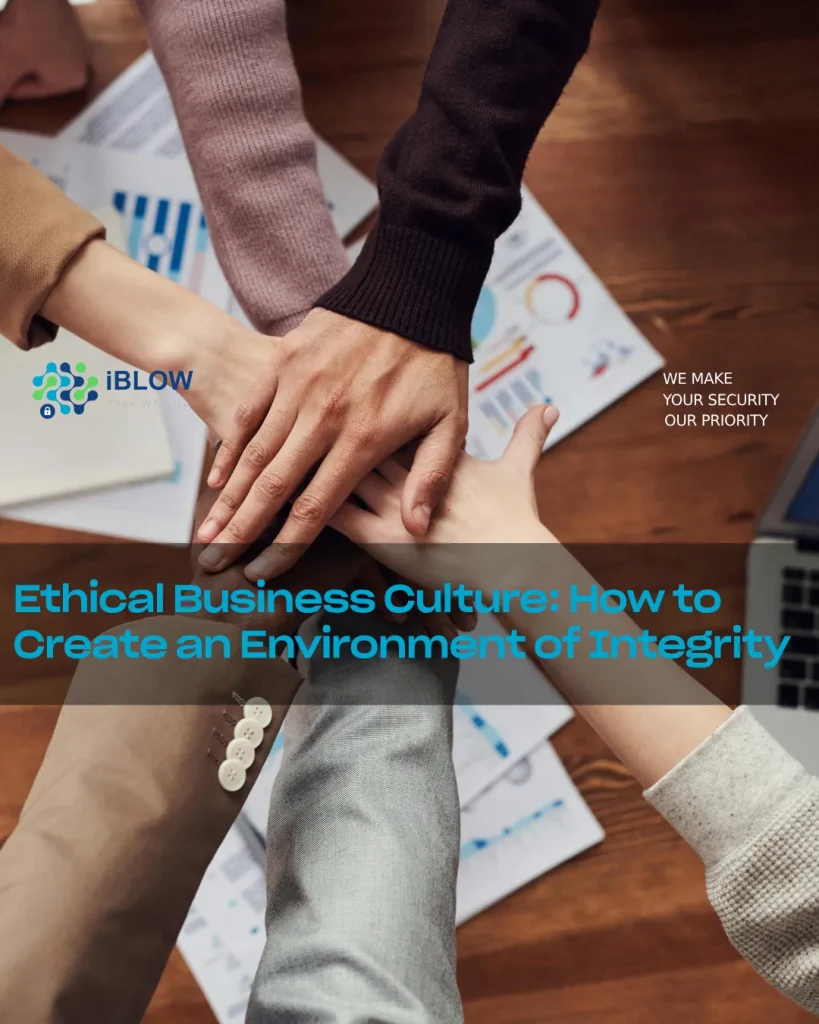
Ethical Business Culture
In an age when transparency and accountability are fundamental requirements for business success, an ethical culture is no longer a competitive differentiator but a prerequisite.
Companies that cultivate integrity not only avoid legal and reputational scandals, but also build healthy working environments, retain talent and win the trust of stakeholders.
This article explores practical strategies for developing and sustaining a solid ethical culture in organisations – especially in SMEs, where resources are limited but ethical risks are just as significant.
What is an Ethical Business Culture?
An ethical business culture is the set of values, norms and behaviours that guide the way employees make decisions within an organisation.
It goes beyond compliance with the law: it involves doing the right thing, even when no one is watching.
Main characteristics:
Transparency in internal and external communication.
Personal and collectiveresponsibility for actions.
Fair treatment of all employees.
Commitment to the common good, above personal interests.
Why is Ethical Culture Vital in Companies?
- Reduction of legal and reputational risks
Unethical behaviour – such as corruption, discrimination or harassment – has a direct impact on reputation and compliance with legal obligations. - Attracting and retaining talent
Qualified professionals look for work environments with integrity, where values such as respect, inclusion and fairness are practised. - Improved organisational performance
Ethical companies have better long-term financial performance, according to various international studies. - Promotion of internal trust
Employees feel more secure, motivated and loyal when they know they are working in a fair organisation.
How to Create an Ethical Culture in Practice?
1. Define and communicate values clearly
Create a code of ethics or conduct that reflects the company’s principles and ensure that all employees are aware of it. Include topics such as:
- Mutual respect
- Avoiding conflicts of interest
- Relations with suppliers and clients
- Policy against retaliation for whistleblowing
2. Leading by example
Ethical culture starts at the top. Leaders and managers must be role models, demonstrating consistency between discourse and practice.
3. Continuous training and sensitisation
Regular training on ethics, compliance and common dilemmas helps employees develop critical thinking and act responsibly.
4. Implement effective whistleblowing channels
Having safe and anonymous mechanisms for reporting irregularities, such as a whistleblowing line, demonstrates the company’s commitment to integrity and protects employees.
5. Reward ethical behaviour
Recognising ethical attitudes in the workplace – for example, in performance appraisals – reinforces the message that doing the right thing is worthwhile.
Common implementation challenges
- Initial scepticism: Many employees may doubt the company’s real commitment to ethics. Leadership consistency will be essential to overcome this resistance.
- Conflicts between results and values: In high-pressure contexts, there can be an incentive to “overstep the rules”. It is essential to demonstrate that the ends do not justify the means.
- Ambiguity in expected behaviour: If values are not translated into practical and measurable actions, they become mere slogans with no real effect.
The Role of SMEs in Promoting Integrity
Although they often don’t have dedicated compliance departments, SMEs have advantages:
- Simpler structures allow for quick changes.
- Greater proximity between leadership and staff makes it easier to communicate values.
- Closer organisational culture makes it possible to instil ethics from day one.
Investing in ethics is an investment in the sustainability of the business.
Conclusion
Creating an ethical business culture is an ongoing process that requires commitment, coherence and involvement from all levels of the organisation.
For companies that want to build lasting relationships with customers, partners and employees, integrity cannot be negotiated – it must be practised every day.
🌱 An ethical culture doesn’t grow out of a document, or out of trees – it grows out of the daily decisions of each person within the organisation.
Call to Action
📘 Want to know how to implement an effective and legally compliant whistleblowing channel?
👉 Go to https://iblow.eu/ and contact us to find out how to protect your company’s integrity with solutions adapted to your size.
👉 Find out more and book a free demonstration
👉 Be part of the conversation that is shaping the future of work! Book a meeting!
👉 See other articles that may be of interest to you.
We hope you enjoyed this article.
Thank you!
Constantino Ferreira
iBlow.eu
