


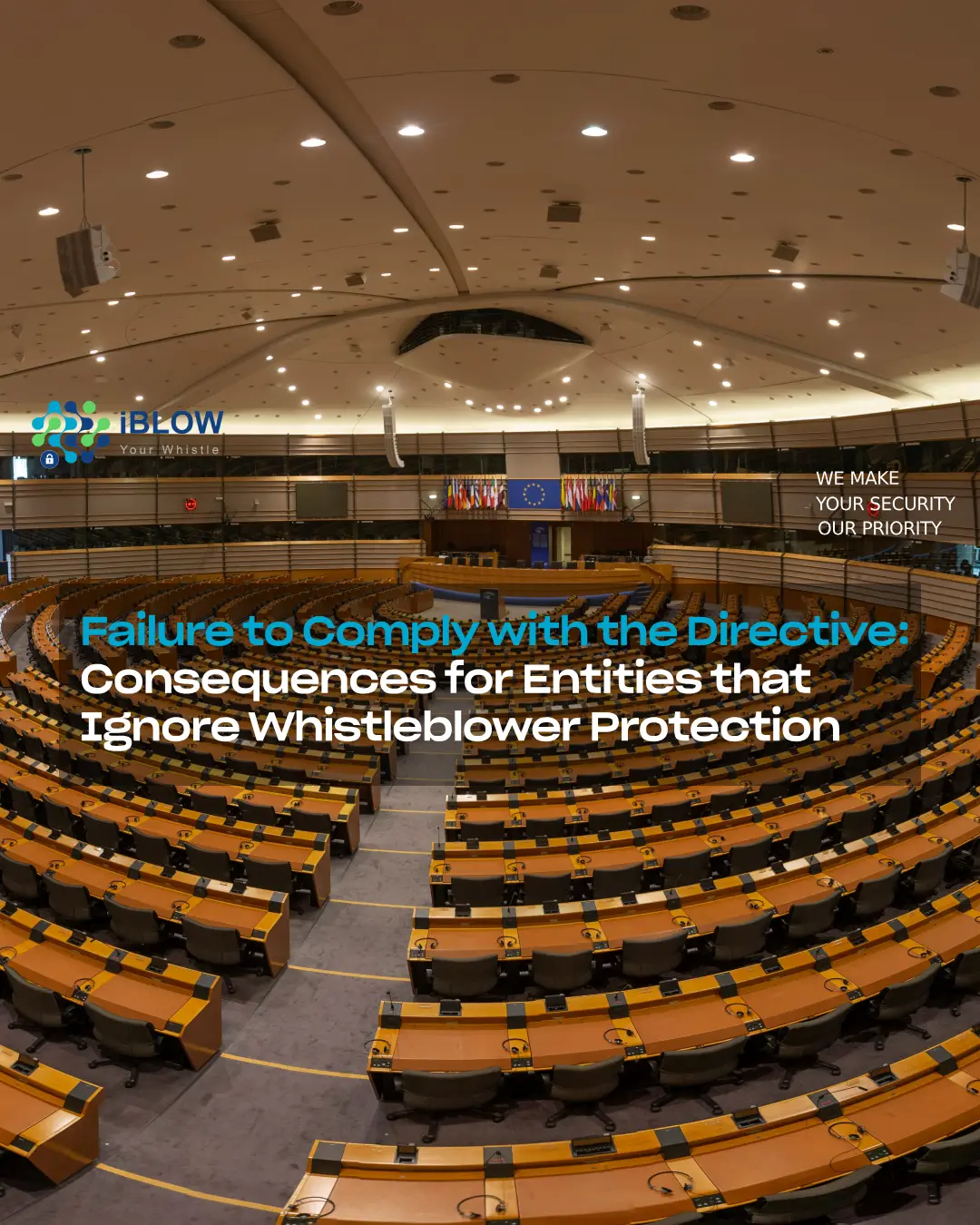
The European Whistleblower Protection Directive, adopted in 2019, sets strict standards for the protection of whistleblowers who report violations of European Union law. This directive aims to ensure that individuals who report illegal activities are protected from reprisals and that their reports are properly investigated. However, many entities have not yet fully complied with these requirements and risk facing serious consequences. This article explores the legal and financial consequences for entities that do not comply with the directive, also highlighting the impact on reputation and public trust. In addition, the iBlow.eu whistleblower management platform is presented, an effective reporting channel that can help entities avoid these consequences.
Legal Consequences of Non-Compliance with the Directive
1. Fines and penalties
One of the most immediate and tangible consequences for organizations that fail to comply with the European Whistleblower Protection Directive is the imposition of fines and penalties. The competent authorities in the Member States of the European Union have the power to impose significant financial penalties on organizations that fail to implement adequate whistleblower protection systems.
-
Amounts of fines
The amounts of fines can vary depending on the seriousness of the infringement and the specific legislation of each country. However, it is common for these fines to be quite high, reaching millions of euros, especially in cases of serious or recurring violations.
-
Types of sanctions
In addition to fines, sanctions can include operational restrictions, suspension of licenses or permits, and even a ban on participating in public tenders.
2. Legal action
Entities that do not comply with the directive may face legal action from whistleblowers or regulatory authorities. Whistleblowers who suffer reprisals due to a lack of adequate protection have the right to go to court to obtain compensation for damages suffered.
-
Legal costs
Legal actions can entail significant legal costs for entities, including lawyers’ fees, procedural costs and potential compensation to whistleblowers.
-
Judgments
Judgments may result in court orders to implement corrective measures, as well as additional fines and other penalties.
3. Increased Supervision and Monitoring
Entities that fail to comply with the directive may be subject to stricter supervision by regulatory authorities. This may include frequent audits, on-site inspections and regular compliance reports.
-
Audits and inspections
Audits and inspections can be costly and disruptive to the day-to-day operations of the entity.
-
Compliance Reports
Frequent reporting requirements increase the administrative burden and can further expose failures or non-compliance.
Financial Impact of Non-Compliance
1. Loss of Contracts and Business Opportunities
Failure to comply with the European Whistleblower Protection Directive can result in the loss of public and private contracts. Many organizations, especially in the public sector, require proof of compliance with all applicable laws and regulations, including whistleblower protection.
-
Public tenders
Non-compliance can lead to exclusion from public tenders, resulting in significant loss of revenue.
-
Business Partnerships
Partners and investors may reconsider their relationships with entities that do not comply with the directive, resulting in lost business opportunities.
2. Fines and Financial Penalties
As mentioned earlier, financial fines and penalties can be extremely costly. For many organizations, these penalties can represent a substantial part of their budget, negatively affecting their financial health.
-
Impact on the budget
High fines can lead to budget cuts in crucial areas such as research and development, marketing and recruitment.
-
Risk of Insolvency
In extreme cases, fines and penalties can be so high that they drive the entity into insolvency.
3. Increased operating costs
Entities that do not comply with the directive may face an increase in operating costs due to the need to quickly implement compliance measures under strict regulatory supervision.
-
Compliance Costs
Implementing compliance systems after a breach can be more expensive than proactive implementation.
-
Consultancy and Advice
Entities may need to hire external consultants to help achieve compliance, further increasing costs.
Impact on Public Reputation and Trust
1. Damage to Reputation
An entity’s reputation is one of its most valuable assets. Failure to comply with the directive can result in significant reputational damage, which can be difficult to repair.
-
Media coverage
Cases of non-compliance often attract negative media attention, amplifying reputational damage.
-
Public Perception
The perception that an entity does not protect whistleblowers can lead to a loss of trust on the part of the public, customers and other stakeholders.
2. Loss of Employee Confidence
Protecting whistleblowers is crucial to maintaining employee trust and morale. Failure to comply can result in a culture of fear and distrust within the organization.
-
Employee morale
Employees who don’t trust whistleblower protection may hesitate to report wrongdoing, affecting ethics and organizational culture.
-
Talent retention
Loss of trust can lead to higher employee turnover, with talent seeking employment in organizations with better compliance and ethics practices.
3. Market Repercussions
Reputation and trust are crucial elements for an organization’s competitiveness in the market. The repercussions of a breach can have long-term effects on the entity’s market position.
-
Share value
Listed companies can see a drop in the value of their shares due to negative market perceptions.
-
Competitiveness
Loss of trust and reputation can hinder the entity’s competitiveness, resulting in loss of market share.
How iBlow Can Help Entities Avoid Unintended Consequences
1. Implementing Effective Reporting Systems
iBlow offers a comprehensive and effective platform for managing reports, helping organizations to comply with the European Whistleblower Protection Directive.
-
Simplicity and Efficiency
The platform is easy to use, allowing whistleblowers to report irregularities simply and securely.
-
Security and Confidentiality
iBlow guarantees the confidentiality of reports, protecting whistleblowers against reprisals.
2. Regulatory Compliance
By using iBlow, organizations can ensure that they comply with all the regulatory requirements of the directive, avoiding penalties and sanctions.
-
Documentation and Reporting
The platform allows for the detailed documentation and reporting required for compliance.
-
Internal audits
iBlow facilitates regular internal audits, identifying and correcting potential problems before they become violations.
3. Improving Organizational Culture
By promoting a culture of transparency and whistleblower protection, iBlow helps to improve employee trust and morale.
-
Employee Engagement
Employees who feel safe reporting wrongdoing are more engaged and motivated.
-
Organizational Ethics
The platform promotes a culture of ethics and integrity, benefiting the organization’s reputation.
Conclusion
The consequences of non-compliance with the Whistleblower Protection Directive are severe and varied, encompassing fines and sanctions, significant financial impacts, as well as damage to reputation and public trust.
To avoid these undesirable consequences, organizations must implement effective whistleblower protection systems.
Using the iBlow platform can be an effective solution to ensure compliance with the directive, protect whistleblowers and promote an ethical and transparent organizational culture.
Check out other articles that may be of interest to you.
We hope you enjoyed this article.
Thank you!