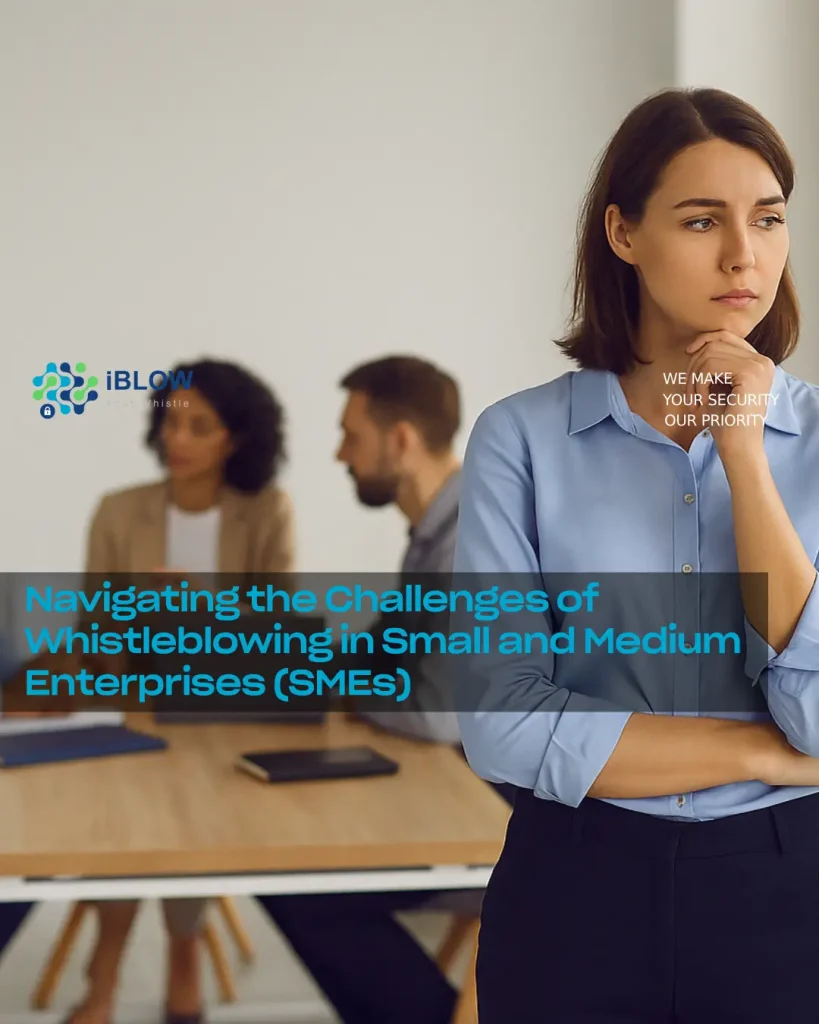
In today’s complex business environment, ethical conduct and transparency are more crucial than ever, that’s why whistleblowing in SMEs: Overcoming Challenges with Practical Solutions is so crucial.
Whistleblowing – the act of reporting unethical or illegal activities within an organisation – plays a vital role in maintaining corporate integrity.
While large corporations have increasingly embraced structured whistleblowing mechanisms, Small and Medium Enterprises (SMEs) often lag behind due to unique structural and cultural challenges.
This article explores the specific obstacles SMEs face in implementing whistleblowing systems and offers practical, scalable solutions to foster a culture of accountability and trust.
Though often perceived as an issue for large corporations, unethical practices are not size-specific.
Fraud, discrimination, harassment, data breaches, and other misconduct can and do occur in SMEs.
What sets SMEs apart is their limited resources and closer interpersonal relationships, which can make whistleblowing more complex and risk-laden.
Implementing an effective whistleblowing system in SMEs is not just about compliance – it’s about protecting the company’s reputation, enhancing employee morale, and encouraging a culture of integrity from the ground up.
Many SMEs operate with tight budgets and lean teams.
Setting up dedicated whistleblowing infrastructure – such as hotlines, third-party reporting platforms, or ethics officers – may seem financially out of reach.
Consequently, whistleblowing policies are often underdeveloped or non-existent.
Solution:
In smaller workplaces, anonymity can be difficult to maintain.
Employees may fear backlash, ostracism, or even job loss for speaking out.
This is particularly concerning when the alleged misconduct involves management or business owners.
Solution:
Many SMEs operate informally, without the kind of structured HR policies found in larger firms.
This can lead to confusion about how to report misconduct or what protections are in place for whistleblowers.
Solution:
SMEs often have strong internal cultures with deep personal ties between employees and managers.
While this can create a supportive environment, it can also discourage whistleblowing, as individuals may be reluctant to speak out against colleagues or friends.
Solution:
New regulations, across every European countries and EU, are expanding protections for whistleblowers.
However, many SME owners and managers are unaware of their legal responsibilities in this area.
This puts them at risk of non-compliance and potential legal action.
Solution:
Don’t let the perfect be the enemy of the good.
Begin with a basic, well-communicated process for raising concerns – even if it’s just a confidential email address monitored by an impartial party.
As your business grows, you can expand the system with more sophisticated tools and processes.
Opt for tools that balance anonymity, security, and ease of use.
Consider cloud-based platforms with encryption and multi-language support if your workforce is diverse.
Make sure employees understand how to access and use the system.
Education is essential. Regular training sessions should cover:
Use real-life case studies and role-play scenarios to make training engaging and practical.
Once a report is received, the response must be timely, consistent, and fair.
Designate a small team or individual responsible for investigations, ideally with experience or training in handling sensitive matters.
Ensure records are kept securely and that outcomes are communicated (while respecting confidentiality).
Employees are more likely to speak up in environments where they feel safe, heard, and valued.
Leadership plays a crucial role in setting the tone.
Celebrate ethical behaviour, respond positively to concerns, and acknowledge the courage of those who raise issues.
As an UK example, existing legislation like PIDA protects whistleblowers in certain circumstances, especially when disclosures are in the public interest.
However, compliance isn’t just about avoiding legal trouble.
Investors, partners, and consumers increasingly scrutinise corporate ethics – and SMEs are no exception.
With the EU Whistleblower Directive coming into force across member states, UK-based SMEs with operations in Europe, the other way around or links to EU supply chains must be aware of cross-border obligations.
Even if not legally mandated, implementing a whistleblowing policy demonstrates good governance and can provide a competitive advantage.
Consider the case of a 50-employee tech startup in Manchester.
After experiencing a data privacy breach, the company realised it lacked a formal mechanism for employees to report concerns.
With help from a compliance consultant, they implemented a secure online reporting platform and rolled out training for all staff.
Within six months, two separate reports led to internal process improvements and prevented a potentially costly compliance violation.
Employees reported feeling more confident in leadership’s commitment to ethical practices.
The initiative also impressed prospective investors, contributing to a successful funding round.
Whistleblowing in SMEs: Overcoming Challenges with Practical Solutions proves that whistleblowing is not just a concern for multinational giants – it’s a fundamental aspect of ethical governance that every SME should take seriously.
While SMEs face unique challenges in implementing whistleblowing mechanisms, these are not insurmountable.
By adopting a proactive approach, leveraging affordable technology, and fostering a culture of openness and integrity, SMEs can turn whistleblowing from a perceived risk into a strategic advantage.
Interested in implementing a whistleblowing mechanism for your SME?
Start with a simple plan and grow from there.
Ethical leadership begins with listening – and whistleblowing is one way your team can help you protect what you’re building.
Be part of the conversation that is shaping the future of work! Book a meeting!
See other articles that may be of interest to you.
We hope you enjoyed this article.
Thank you!
Constantino Ferreira
iBlow.eu
 Liked? Subscribe to receive future articles
To go deeper on whistleblowing in SMEs, see also:
Official source: Directive (EU) 2019/1937.