

iBlow logo
iBlow Logo
  • About
  • Services
  • Features & Packages
  • Resources
  • Contact
  • FAQ
  • Request a demo
  • EnglishEnglish
    • PortuguêsPortuguês
  • About
  • Service
  • Features & Packages
  • Resources
  • Contact
  • FAQ
iBlow logo
  • About
  • Services
  • Features & Packages
  • Resources
  • Contact
  • FAQ
  • Request a demo
  • EnglishEnglish
    • PortuguêsPortuguês

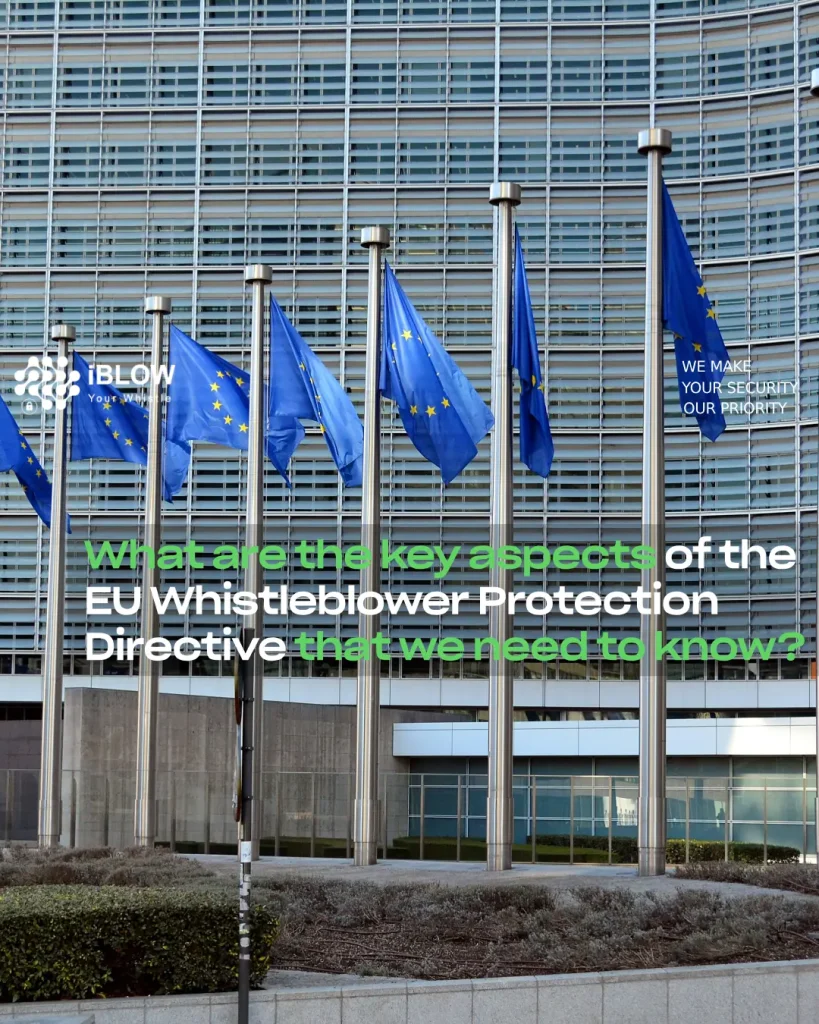
What are the key aspects of the EU Whistleblower Protection Directive that we need to know?

What are the key aspects of the EU Whistleblower Protection Directive that we need to know?

The EU Whistleblower Protection Directive (Directive (EU) 2019/1937) sets out comprehensive rules to protect individuals who report breaches of EU law across a wide range of areas. It aims to standardize whistleblower protection across all EU member states and ensures that whistleblowers are shielded from retaliation. Here are some of the key aspects of the directive that organizations and individuals need to know:

  1. Scope of the Directive

It covers individuals who report breaches of EU law in a wide range of sectors, including:

  • Public procurement
  • Financial services, money laundering, and terrorist financing
  • Product safety and compliance
  • Environmental protection
  • Public health
  • Consumer protection
  • Data protection and privacy
  • Competition law and state aid

This directive applies not only to employees but also to a broad group of potential whistleblowers, including contractors, suppliers, shareholders, job applicants, and former employees.

  1. Internal and External Reporting Channels

The whistleblower directive mandates that organizations with 50 or more employees (or municipalities with more than 10,000 residents) must establish internal reporting channels for whistleblowers to safely report concerns. These internal channels must:

  • Ensure the confidentiality of the whistleblower’s identity.
  • Be independent and impartial in handling reports.
  • Acknowledge receipt of the report within 7 days.
  • Provide feedback to the whistleblower within 3 months.

In addition to internal channels, whistleblowers are allowed to report directly to external authorities (such as regulators or oversight bodies) if:

  • Internal channels are not functioning properly.
  • The whistleblower fears retaliation.
  • The breach poses a clear and imminent danger to the public interest.

Whistleblowers may also disclose information publicly (e.g., to the media) if:

  • No action is taken in response to their report.
  • They reasonably believe that public disclosure is necessary due to an immediate danger.
  1. Protection from Retaliation

One of the cornerstone provisions of the directive is protection from retaliation. Whistleblowers who report in good faith are protected from a wide range of retaliatory actions, including:

  • Dismissal or demotion
  • Discrimination or harassment
  • Denial of promotions or pay raises
  • Any form of retribution (e.g., changes to job duties or working conditions)

If retaliation does occur, the burden of proof is on the employer to demonstrate that any action taken against the whistleblower was unrelated to their report.

  1. Anonymous Reporting

While the directive encourages organizations to accept anonymous reports, it does not make it mandatory. This is left to the discretion of individual EU member states when transposing the directive into national law. However, organizations must handle all reports—anonymous or not—with the same degree of seriousness and confidentiality.

  1. Broad Definition of Whistleblowers

The directive offers protection to a wide range of individuals beyond traditional employees. This includes:

  • Trainees and interns
  • Job applicants who become aware of misconduct during the hiring process
  • Contractors and suppliers
  • Freelancers and temporary workers
  • Individuals who assist the whistleblower in making the report (e.g., colleagues or family members)

This broad scope is meant to ensure that anyone with knowledge of wrongdoing has a safe avenue for reporting.

  1. Confidentiality Requirements

One of the key requirements is to ensure the confidentiality of the whistleblower’s identity throughout the reporting process. Any person involved in receiving or processing reports is bound by confidentiality, and any breach of this could result in penalties.

This ensures that whistleblowers are protected from exposure to their colleagues, managers, or other parties that could potentially retaliate against them.

  1. Follow-up and Feedback

Organizations are required to provide feedback to whistleblowers within a reasonable timeframe. Specifically:

  • Acknowledge the receipt of the report within 7 days.
  • Provide feedback on the action being taken (or not) within 3 months.

This ensures that whistleblowers are kept informed of the progress and are assured that their concerns are being taken seriously.

  1. Support Measures for Whistleblowers

The directive mandates that member states provide support and protection measures for whistleblowers, including:

  • Legal assistance in case of retaliation claims.
  • Psychological support or counseling.
  • Information about the available reporting channels and how whistleblowers are protected.

These provisions aim to minimize the emotional and financial burden on whistleblowers.

  1. Reverse Burden of Proof in Retaliation Cases

In cases where a whistleblower claims retaliation, the burden of proof shifts to the employer. This means that employers must demonstrate that any negative action taken against the whistleblower was not linked to their report. This significantly strengthens the position of whistleblowers in legal disputes related to retaliation.

  1. Penalties for Non-Compliance

The directive leaves it to individual EU member states to determine the penalties for non-compliance, but these penalties could include:

  • Fines for organizations that fail to implement reporting channels.
  • Sanctions for those who retaliate against whistleblowers.
  • Legal consequences for individuals or organizations that obstruct whistleblowers or fail to protect their identity.
  1. Transposition into National Law

The directive sets minimum standards, and each EU member state is responsible for transposing the directive into national law. Member states are allowed to extend the scope and protections beyond the EU-wide standards if they wish, meaning that there could be some variation in how whistleblower protections are implemented across the EU.

  1. Extended Areas of Reporting (Optional)

While the directive primarily focuses on breaches of EU law, member states are free to extend protections to whistleblowers reporting violations of national laws or other areas of wrongdoing not explicitly covered by the directive.

Key Takeaways for Organizations

  1. Establish Internal Reporting Channels: Companies with 50+ employees must set up internal reporting mechanisms that comply with the directive’s requirements for confidentiality, feedback, and protection from retaliation.
  2. Train Employees and Management: Ensure that employees understand how to use the reporting channels and that managers know how to handle whistleblower reports in a manner that ensures protection and confidentiality.
  3. Regularly Review and Update Policies: Organizations must regularly review their whistleblower policies and procedures to ensure compliance with the directive and adapt to any changes in national regulations.
  4. Ensure Legal and HR Involvement: Legal and HR teams need to collaborate to ensure that whistleblower protections are enforced and to mitigate the risk of retaliation claims.
  5. Promote a Safe Culture: Build a workplace culture where employees feel safe and encouraged to report misconduct, knowing that their concerns will be addressed in a confidential and respectful manner.

By understanding and implementing these key aspects of the directive, organizations can create a safer, more transparent environment that fosters trust and integrity while also staying compliant with the law.

Be part of the conversation shaping the future of work! Schedule an appointment!

Revisit the video where this topic began.

See other articles that may be of interest to you.

We hope you enjoyed this article.

Thank you!
iBlow.eu

Make compliance a confident part of how you grow.

Tell us what your organisation needs. We’ll help you find the right next step.
Talk to our team
Stylized text with abstract design
Secure reporting and practical compliance support for organisations that want to build trust and act with confidence.

Explore

About iBlow
Services
Features & packages
Resources
Law 93/2021 in 9 points
FAQs

Choose your next step

Book a demonstration
Request a proposal
Get the practical guide
Request a free trial

Contact

+351 210 987 308
[email protected]
Rua Mouzinho da Silveira 32
Lisboa, Portugal

Privacy policy · Terms · Cookies
© 2026 iBlow Europe. All rights reserved.
iBlow Europe
Manage Consent

To provide the best experiences, we use technologies like cookies to store and/or access device information. Consenting to these technologies will allow us to process data such as browsing behavior or unique IDs on this site. Not consenting or withdrawing consent, may adversely affect certain features and functions.

Functional Always active
The technical storage or access is strictly necessary for the legitimate purpose of enabling the use of a specific service explicitly requested by the subscriber or user, or for the sole purpose of carrying out the transmission of a communication over an electronic communications network.
Preferences
The technical storage or access is necessary for the legitimate purpose of storing preferences that are not requested by the subscriber or user.
Statistics
The technical storage or access that is used exclusively for statistical purposes. The technical storage or access that is used exclusively for anonymous statistical purposes. Without a subpoena, voluntary compliance on the part of your Internet Service Provider, or additional records from a third party, information stored or retrieved for this purpose alone cannot usually be used to identify you.
Marketing
O armazenamento ou acesso técnico é necessário para criar perfis de utilizador para enviar publicidade, ou para localizar o utilizador num site ou em vários sites para fins de marketing semelhantes.
  • Manage options
  • Manage services
  • Manage {vendor_count} vendors
  • Read more about these purposes
View preferences
  • {title}
  • {title}
  • {title}